 VGarage


The habits that really save fuel are boring ones: accelerate and brake gently, keep your speed sensible on the highway, don't idle for long, keep the tires at the right pressure, and don't carry weight or a roof box you don't need. The US Department of Energy's fueleconomy.gov has measured most of these, and the biggest single win is smooth driving: aggressive driving can lower fuel economy by 10% to 40% in stop-and-go traffic. Below are the habits with real numbers behind them, and how to check what they do for your own car.
The short version
- Drive smoothly. Gentle acceleration and early, gradual braking matter more than anything else you can do.
- Ease off on the highway. Fuel use climbs quickly above about 80 km/h.
- Cut the extras: long idling, an empty roof box, junk in the trunk.
- Keep the car in shape: right tire pressure, the oil grade your manual specifies.
The habits that save fuel
Drive smoothly
Hard acceleration, late braking and speeding waste fuel. fueleconomy.gov puts the cost of aggressive driving at roughly 15% to 30% at highway speeds and 10% to 40% in stop-and-go traffic. That's the range where most city driving happens.
- Pull away gently. Squeeze the accelerator rather than stamping on it.
- Look far ahead. If the light ahead is red or traffic is bunching up, lift off early and coast instead of braking hard at the last moment.
- Leave a gap. A bigger following distance gives you room to slow down smoothly instead of braking every time the car in front does.
It's also safer and easier on your brakes, which is a nice bonus. See when to replace brake pads.
Watch your highway speed
Air resistance grows fast with speed. fueleconomy.gov says fuel economy usually drops quickly above 50 mph, which is about 80 km/h, and that slowing down by 5 to 10 mph (about 8 to 16 km/h) can improve fuel economy by 7% to 14%. On an expressway, holding 90 km/h instead of 110 km/h uses noticeably less fuel for only a few extra minutes on most trips.
On long, flat stretches, cruise control helps you hold a steady speed, and fueleconomy.gov says it will save fuel in most cases. Always keep to the posted limits and drive at a speed that's safe for the road and the traffic.
Don't idle longer than you need to
An idling engine gets zero kilometres per litre. fueleconomy.gov says idling uses roughly a quarter to a half gallon of fuel an hour, about 1 to 2 litres, depending on the engine and the aircon, and that restarting a warm engine uses only about 10 seconds' worth of fuel.
- Waiting in a parking lot or for a pickup? Switch off if you'll be stopped for more than a minute or so, where it's safe to do so.
- Don't warm up the engine by idling for minutes. Modern engines warm up faster when you drive off gently.
- Never switch off in moving traffic or anywhere you may need to move quickly. Safety first; a few drops of fuel aren't worth it.
Use the aircon wisely
In a hot country you can't do without aircon, and you don't need to. But it is the main reason fuel economy drops in hot weather: fueleconomy.gov says it can cut a conventional car's economy by more than 25% in very hot conditions, especially on short trips. Some easy wins:
- Park in the shade or use a sunshade, so the cabin starts cooler.
- Open the windows for a minute before you set off to let the hottest air out.
- Windows at low speed, aircon at high speed. Open windows add drag, which matters little in town but more on the highway.
Lighten the load
- Take off the roof box when you're not using it. A large one can cost 6% to 17% on the highway, and 10% to 25% at expressway speeds of about 105 to 120 km/h. A rear-mounted carrier costs much less, about 1% to 5% on the highway.
- Clear out the trunk. fueleconomy.gov estimates about 1% more fuel for every 100 pounds (about 45 kg) of extra weight. Smaller cars feel it more.
Plan and combine trips
An engine uses more fuel when it's cold. fueleconomy.gov says several short trips, each from a cold start, can use twice as much fuel as one longer trip that covers the same errands. Do the school run, the grocery and the bank in one loop instead of three. Leaving before or after the worst traffic helps too.
Keep the car in shape
- Tire pressure. Under-inflated tires cost about 0.2% for every 1 psi drop in average pressure. Keeping them at the pressure on the door sticker improves economy by about 0.6% on average, and up to 3%. More in tire pressure and rotation.
- The right oil. Using a heavier grade than your engine is designed for, such as 10W-30 in an engine that calls for 5W-30, can cost 1% to 2%.
- Don't ignore the check engine light. Some faults raise fuel use, and fixing them early is cheaper.
Common mistakes
- Buying gadgets and additives that promise big savings. The habits above are what agencies have measured. Be sceptical of anything that sounds too good.
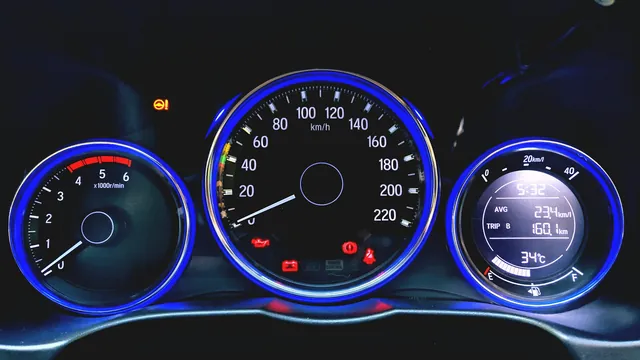
- Judging by the trip computer or by feel. Measure from fill-up to fill-up instead.
- Coasting in neutral down hills. It gives you less control of the car, especially when you need to brake or speed up suddenly. Stay in gear and follow your owner's manual.
- Expecting the same gains as someone else. These are averages from US testing. Your car, roads and traffic decide what you actually save.
Tips for making it stick
- Change one habit at a time for a few tanks, so you can see what it does.
- Use full-to-full measurements. Our guide to calculating fuel consumption shows how.
- Expect some noise. Traffic and weather vary week to week, so look at the trend over a month, not one tank.
If your economy gets worse even though you're driving the same, something else is going on. See why your fuel economy suddenly got worse.
Track it with VGarage
Saving fuel is easier when you can see the result. In VGarage, log each fill-up with the odometer, the volume and the price, and mark whether you filled the tank. You can scan the receipt or the pump display to fill in the numbers. VGarage works out your economy from full tank to full tank, in km/L or L/100km, and the charts show how it moves over time. Try a month of smoother driving and look at the trend line: that's your real saving, measured on your own car.
Track it with VGarage
VGarage keeps every fill-up, service and cost for all your cars on iPhone: scan the pump and the receipt, get service reminders by date or odometer, and see what each car really costs to run.